
Zeta Phi Chapter to go inactive due to membership declines
This communication is the first in a four-part newsletter series to be sent to AXP Zeta Phi alumni. The topics are as follows:
a) Membership Declines
b) Our 70th Anniversary Reunion/Celebration – July 10–12, 2026
c) The Status of the House
d) The University
Given the amount of information to be shared, each topic will be sent as a separate post. Links to each letter will also be posted on our alumni Facebook page and web site.
In this installment, I will cover the rise and fall of Zeta Phi membership over the years; explore possible causes of recent membership declines and how we got to where we are; recent efforts by the chapter and the Building Corp to turn things around, as well as obstacles to those efforts; and begin a discussion of next steps.
We also want to make you aware of our 70th Anniversary Celebration on July 10-12, 2026 which has been in the planning stages for the past several months and is still happening. We hope to see you there!
If you have questions regarding this email, a Q&A session will be held via Microsoft Teams on Thursday, May 7, at 8:00pm Eastern. A link to the meeting is here: Microsoft Teams Meeting
Membership Declines
As many of you already know, membership in the Zeta Phi Chapter of Alpha Chi Rho has been declining for several years. Several factors—occurring at different times—have contributed to recruitment challenges. These include COVID, our status as an off-campus house, the physical condition of the house, disciplinary actions involving Greek houses, university policies and support, declining male enrollment at Clarkson, and a general shift in student interests away from fraternities and toward other clubs and activities.
This has been especially noticeable in the last six years, and the result is that next year, we will have only two active members. Due to the amount of work involved with the perceived minimal chance of success, the two brothers are reluctant to continue the recruitment effort. This unfortunately means that the Zeta Phi Chapter will have to go inactive.
To understand what led to this situation, I did some research.
Historical Membership Summary
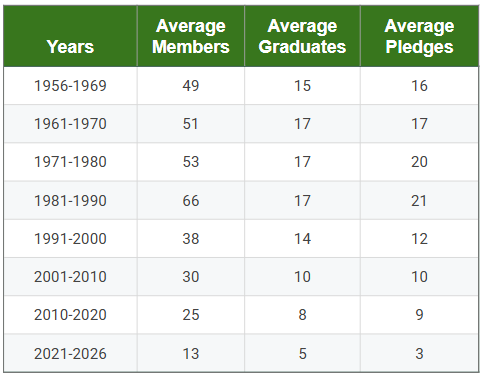
Average membership, graduates, and pledges over time are summarized below:
1956-1975
From 1956 through 1975, Zeta Phi membership was strong, with increases occurring in approximately 50% of those years. Membership during this period never fell below 37 members.
In fall 1971, the Science Center became the first building constructed on Clarkson’s Hill Campus, marking the beginning of the transition away from downtown academic facilities.
The fire destroyed the house on December 20, 1975.
1976-1990
After the fire, the new house was completed in 1976 (thank you, Al Post). Membership increased steadily over the following 12 years.
Membership increased during the period when the legal drinking age changed (1982–1985).
Membership also increased despite continued development of the Hill Campus. The Indoor Recreation Center (IRC), which includes a pool, indoor track, and recreation areas, and the Educational Resource Center (ERC), which housed the library and student center, both opened in 1980.
1990-2000
By 1990, essentially all undergraduate classes and activities had moved to the Hill Campus. Zeta Phi membership began declining that same year.
Over the next five years, the chapter lost 33 members, declining to 40 members. Over the subsequent six years, membership dropped by another 11 members, reaching 29 by the year 2000.
Beginning in the mid-1990s, incidents at Greek houses—both nationally and locally—resulted in suspensions and shutdowns. From 1995 to 1998, there was significant national negative attention related to hazing and alcohol-related incidents. This increased scrutiny and regulation and discouraged potential pledges and their parents.
During this period, Hill Campus development continued, including Rowley Labs (1987), Cheel Arena/Campus Center (1991), CAMP (1991), and the new Snell Hall for Business (2000).
2001-2019
During the 2000s and again in the 2010s, Clarkson significantly tightened oversight of Greek life. This caused several Greek Houses to get suspended, including Zeta Phi for infractions in 2007 and 2010. During those years, we were only able to get 1 or 2 pledges.
Additions of more Clarkson apartments in 2000 and improvements to Clarkson’s dorms in 2009, 2010 and 2012 led to more on campus room alternatives.
The Student Center was complete in 2010.
Despite this, the chapter experienced two periods of membership growth:
2001–2003: membership increased from 29 to 45
2009–2013: membership increased from 19 to 27
However, the overall trend remained downward. Membership stabilized between 16 and 32 members until 2020, when the chapter had 26 members, including nine new pledges.
2020-2026
The decline accelerated beginning in the 2019–2020 academic year. COVID severely disrupted college campuses beginning in spring 2020, when classes moved fully online. Although students returned to campus in fall 2020 and spring 2021, many classes remained online or hybrid, with extensive restrictions still in place.
As a result, the chapter essentially lost a full rushing year. In five of the six years between 2020 and 2026, the chapter received a total of only three pledges.
In 2023, the chapter recruited 12 pledges, most of whom have since graduated. Four members graduate this year, leaving only two members moving forward.
So, What Happened?
I do not believe there is a single explanation. Membership numbers tell part of the story, but multiple factors combined to create what I view as a “perfect storm”:
With all undergraduate academics and activities on the Hill Campus—including the ERC, IRC, and Cheel Arena—there is less incentive for students to go downtown.
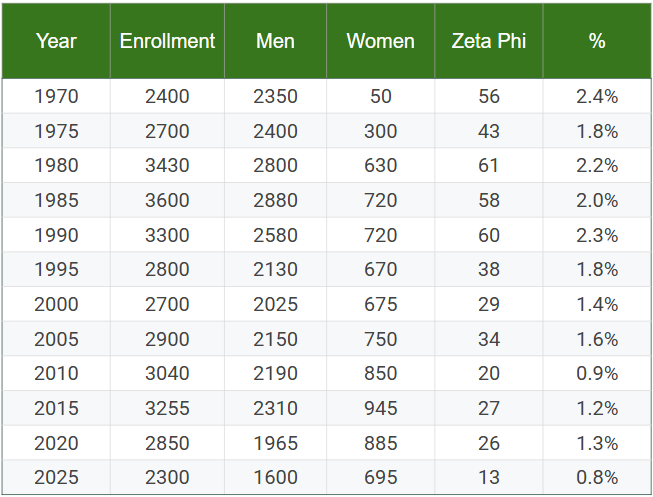
Declining Clarkson enrollment, particularly among male students, reduced the pool of potential fraternity members. Then factor in that in 1990 (when all undergraduate classes were on the hill), the struggle to maintain an off-campus fraternity led to percentage declines in membership as compared to the mail undergraduate population. Finally, the sudden drop in enrollment in part due to COVID, and Clarkson’s admissions difficulties led to a dramatic slide in the last 6 years. This effect is illustrated below:
Clarkson’s rules and regulations regarding Greek life significantly increased time demands on members. Under the pretext of students’ rights, Clarkson makes it difficult for alumni to provide direct assistance to the Chapter in University affairs. Clarkson has lost sight of the value that alumni can provide in support of areas other than university fundraising.
There is a critical point where declining membership reduces mentorship and continuity, resulting in loss of traditions and institutional chapter knowledge. The change from a senior class president to a junior class president didn’t help in this regard.
Fewer members meant more work per member, including house maintenance, committee responsibilities, and recruitment.
The number of student clubs, academic commitments, and competitions have increased substantially, competing for student time.
COVID disrupted normal operations and recruitment across multiple semesters.
The house’s condition deteriorated in the early 2020s. While significant investments were made in 2024 and 2025, these improvements didn’t seem to change the perspectives of living off campus.
Recent declines in membership numbers created uncertainty regarding chapter continuation, which deterred prospective members.
On-campus fraternities have an easier rush, their numbers are larger, you can walk to everything, and you have nothing to maintain. The perception of increased campus scrutiny is offset by convenience. In spring 2025, only 20 pledges were recruited (following a 150-student drop in freshmen enrollment), most of whom joined on-campus houses. In spring 2026, 40 pledges were recruited, 37 of whom joined one of four on-campus fraternities.
Building Corp Efforts
COVID limited the Building Corporation’s ability to assist in those years.
Last year, the alumni and brotherhood improved the physical house issues that might deter recruitment. The Building Corp also showed support by providing rush shirts and other assistance.
This year, alumni involvement increased with the House Improvements and included rush flags, brochures, activity fair and rush event supplies. The undergrads improved their social media presence both with Clarkson and AXP websites. The Building Corporation made housing cost guarantees to save students $5,000 per year as compared to Clarkson rates. I was on campus for a couple of days during each rush period this year. The Chapter got direct participation from AXP National during the entire week-long Continuation of Bid effort.
Conclusion
This is not a letter I expected to write, nor a decision I expected to oversee. And I forgot but was just reminded that I was Building Association President in 1976 when the new House was built which makes this suck even more.
After extensive discussion between the Building Corporation, AXP National, and the remaining two members, we have concluded that the Zeta Phi Chapter and house will go inactive in August 2026. With only two members remaining, the workload and regulatory requirements make continuation unrealistic.
The future of the house at 77 Elm Street will be discussed at upcoming Building Corporation meetings. No actions will be taken prior to graduation on May 9, 2026, or before the 70th Anniversary celebration on July 10–11, 2026. Proceeds from any future sale will be discussed at the annual meeting on July 11, 2026.
Still, there are bright spots ahead, particularly our 70th Anniversary Celebration, which may be the final opportunity to enjoy the house as it has been known for decades with Brothers you may not have seen for awhile. After the annual meeting Saturday we will be having a chicken BBQ and party featuring live music by Double Axel — all at the house. More details to follow soon.
And who knows what the future may bring—perhaps one day, Zeta Phi will return, somewhere, somehow.
YFB,
Ross Williamson
AXP Zeta Phi Building Corporation President
Clarkson ‘74, ‘77